
For many organisations, accounts receivable (AR) is still defined by manual effort, fragmented workflows and delayed visibility. Teams rely on static reports, generic reminder emails and disconnected systems to manage what is ultimately one of the most important drivers of cash flow.
That model is quickly becoming outdated.
A new generation of AR technology is emerging, built around automation and AI. Rather than reacting to overdue invoices, finance teams can now identify risk earlier, prioritise more effectively and act with consistency at scale. This shift is at the core of CreditorWatch Collect, an accounts receivable platform designed to bring intelligence and automation into a single workflow.
At the centre of Collect is a simple but powerful idea: your receivables are already signalling risk – you just need the right system to surface and act on it.
Making risk visible with Priority Intelligence
One of the biggest challenges in AR is knowing where to focus. Traditional reporting tells you what has already happened – overdue invoices, ageing buckets and historical trends. What it doesn’t do is highlight where risk is emerging.One of the biggest challenges in AR is knowing where to focus. Traditional reporting tells you what has already happened – overdue invoices, ageing buckets and historical trends. What it doesn’t do is highlight where risk is emerging.
Priority Intelligence addresses this gap.
It analyses changes in payment behaviour and surfaces early warning signs within the ledger, helping teams identify accounts that are deteriorating, going quiet or carrying high value at risk. Instead of working through a static list, AR teams are presented with a prioritised view of where attention is needed most.
For finance leaders, this translates into earlier visibility of potential cash flow disruption. For AR teams, it removes guesswork, replacing manual triage with a clear, data-driven action list.
Bringing AI into communications with SmartSend
Once risk is identified, the next challenge is acting on it quickly and appropriately. This is where many AR processes break down.
Today, AR email workflows are often clunky and inconsistent. Teams switch between systems to gather context, draft messages from scratch and manually adjust tone depending on the situation. The result is time-consuming and difficult to standardise.
We’ve recently launched SmartSend to address this challenge – an AI-powered communications capability built directly into Collect, powered by Claude.
SmartSend uses key data points such as invoice status, age of overdues and customer history to automatically generate contextual, tailored communications. This includes payment reminders as well as responses to disputes or queries. It helps AR teams:
- Generate more relevant and timely payment reminders
- Create tailored responses without starting from scratch
- Reduce repetitive drafting work
- Maintain a consistent tone – whether empathetic, neutral or firm
- Focus efforts on higher-value conversations rather than administrative tasks.
By embedding this capability within the workflow, SmartSend removes the friction of switching between tools and ensures that communications are both consistent and have the correct tone.
Removing friction from payments with AutoPay
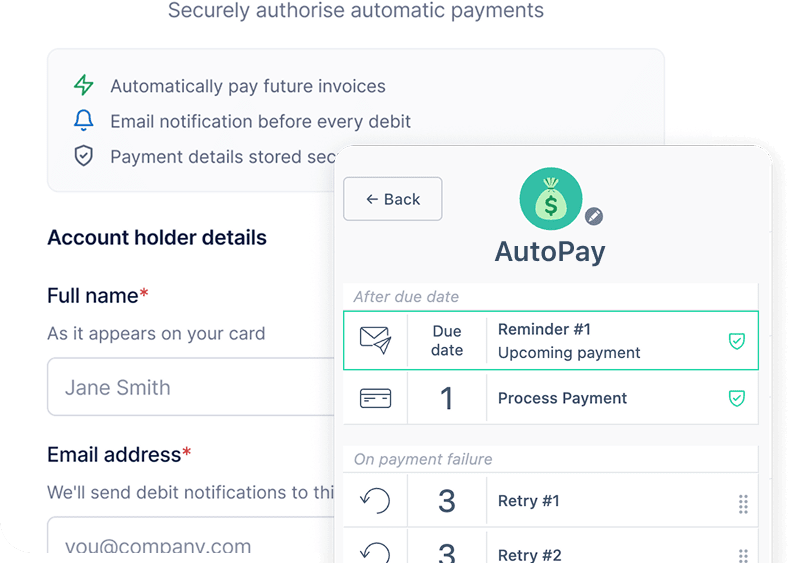
Even when engagement is strong, payment delays can persist due to process inefficiencies. Manual payment steps, unclear options or unnecessary friction can all slow down the final stage of the AR cycle. AutoPay is designed to remove that friction.
By streamlining the payment experience and making it easier for customers to settle invoices, it supports faster collections without adding pressure to the relationship. It complements both Priority Intelligence and SmartSend by ensuring that once action is taken, the path to payment is as simple as possible.
A connected system for AR performance
Individually, each of these capabilities delivers value. Together, they fundamentally change how AR operates.
- Priority Intelligence identifies where risk is emerging
- SmartSend enables fast, consistent and context-aware communication
- AutoPay ensures that once engagement happens, payment is frictionless.
This creates a continuous workflow: see risk early, prioritise effectively and act with confidence.
Importantly, this approach aligns with a broader shift in how finance teams think about AR – not as a collections function, but as a driver of working capital performance. By combining AI and automation across the entire process, teams can spend less time on repetitive tasks and more time on strategic decision-making.
Why this matters now
As businesses grow, AR complexity increases. Invoice volumes rise, customer relationships become more nuanced and the cost of delayed or missed signals grows. The opportunity is not just to automate what already exists, but to rethink how AR operates entirely.
Collect is built around this vision: a single workspace where teams can manage receivables with clarity, consistency and control, using AI to reduce manual effort and improve outcomes.
For BIIA members, the shift is clear. The future of AR is not about chasing payments more efficiently. It is about understanding risk earlier, acting more intelligently and turning receivables into a source of strategic advantage.


Comments are closed.